The traditional image of a university student—huddled over a notebook with a single pen—has officially become a relic of the past. As we move through 2026, the definition of “studying” has undergone a radical transformation. Today, a student’s success is no longer measured solely by their ability to memorize facts or sit through a two-hour lecture. Instead, a new metric has emerged: Technical Literacy. This isn’t just about knowing how to send an email or navigate a search engine; it is the sophisticated ability to use specialized digital tools to solve academic problems, visualize data, and communicate complex ideas to a global audience.
For the modern undergraduate, technical literacy functions as a high-value currency. In a world where hybrid learning is the standard and AI-driven platforms are reshaping every syllabus, students who master the “digital layer” of their education find doors opening that remain closed to others. However, this shift has also introduced a significant “skill gap.” Many students arrive at university prepared for the academic rigors of their subject but completely unprepared for the technical execution required to submit professional-grade work.
The Emerging Struggle of the Modern Undergrad
This gap is most visible during the first few years of a degree. A student might have a brilliant grasp of sociological theory or business strategy, but they hit a wall when asked to present that theory in a multi-modal report or a data-driven essay. The pressure to maintain high grades while simultaneously learning the “hidden curriculum” of digital tools creates an immense amount of stress. It is during these high-pressure moments that many students realize that being a “lone wolf” is no longer the most efficient path to success.
In response to these rising standards, many proactive learners have turned to external mentorship to stay ahead. Utilizing professional assignment writing help from established platforms like MyAssignmentHelp has become a common strategy for students looking to balance their heavy workloads. By collaborating with experts who understand global academic standards, students can ensure their submissions are structurally sound and polished, giving them the breathing room they need to focus on mastering the actual software and technical skills their future careers will demand.
Why Digital Fluency Outranks Traditional Memory
In 2026, the “Global Education Outlook” highlights a major pivot: education is moving away from experimentation with technology and toward total execution. Employers no longer ask if you know a subject; they ask if you can apply that subject using industry-standard software. Whether you are in finance, healthcare, or marketing, your “Technical IQ” is often what determines your starting salary.
| The Evolution of the Undergraduate Experience | 2016 Era | 2026 Era |
| Submission Format | Standard PDF / Word Doc | Interactive, Multi-modal Reports |
| Research Foundation | Static Library Databases | Real-time Data & AI-Assisted Synthesis |
| Key Software Requirement | Basic Office Suites (PPT/Excel) | Niche Mastery (CAD/Python/Tableau) |
| Evaluation Focus | Subject Knowledge | Knowledge + Technical Proficiency |
This table illustrates the jump in expectations. A student is now an “information architect.” You aren’t just writing; you are building an argument using various digital bricks. If those bricks aren’t laid precisely, the entire project loses its professional value.
Bridging the Gap in Technical Streams
The challenge becomes even more acute for students in STEM (Science, Technology, Engineering, and Mathematics) or Architecture. In these fields, the “Academic Currency” is literal software proficiency. A civil engineering student, for instance, is expected to transition from hand-drawn concepts to 3D digital models almost overnight. The theory of structural integrity is taught in the classroom, but the mastery of the tools used to prove that integrity—like AutoCAD—is often left to the student to figure out.
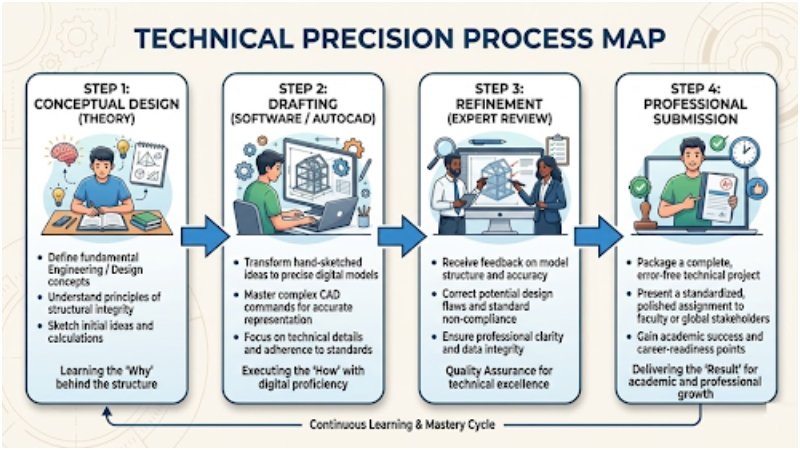
This is a daunting hurdle. When a project requires perfect precision and the software is complex, the margin for error is zero. To bridge this divide, many students seek out specialized autocad assignment help from the technical experts at MyAssignmentHelp to ensure their digital blueprints meet the exacting standards of modern universities. This isn’t just about getting a grade; it’s about learning the “workflow” of a professional. By seeing how an expert structures a technical drawing, a student gains a visual template for their own future projects, effectively buying back the time they need to truly “learn by doing.”
The Rise of the “Portfolio Mindset”
To rank among the top of your class today, you must treat every assignment as a potential portfolio piece for a future employer. The global job market in 2026 is hyper-competitive, and recruiters are looking for “proof of skill.” If your essay on urban sustainability includes a perfectly rendered 3D map or a data visualization that you created yourself, you have moved beyond being a student—you have become a practitioner.
Technical literacy allows you to turn abstract ideas into tangible results. It gives you a “voice” in the digital economy. This is why universities are now embedding experiential learning and challenge-based projects into their core curriculum. They recognize that a degree without technical literacy is like a car without fuel; it might look good, but it won’t take you anywhere in the professional world.
Navigating the Future with Confidence
As we look ahead, the integration of digital tools will only accelerate. We are moving toward a reality where “digital skills” are no longer a separate category on a resume—they are the resume. For undergraduate students, the message is clear: do not fear the technology, and do not be afraid to seek support when the technical demands exceed your current training.
Whether it is mastering a new coding language, refining your academic writing for a global audience, or learning the intricacies of design software, every bit of technical literacy you acquire is an investment in your future self. The students who thrive in 2026 are those who view their education as a collaborative journey, utilizing every resource available to build a bridge between their classroom dreams and their career reality.
Frequently Asked Questions (FAQ)
- What does “Technical Literacy” mean for a student in 2026?
Ans: It refers to the ability to effectively use, manage, and evaluate digital tools to complete academic work. This includes everything from basic research skills to mastering specialized industry software like AutoCAD or data analytics tools.
- Why is there a skill gap for current undergraduate students?
Ans: Many students are taught the “what” (theory) but not the “how” (technical execution). As universities raise their standards for digital submissions, students often find they lack the specific software training needed to meet those expectations.
- Is using academic support services considered a common practice?
Ans:Yes, in 2026, many students view academic support as a form of “managed services” for their education. It allows them to maintain high-quality outputs while. They focus on gaining the deep technical expertise required for their specific career path.
- How can I improve my technical literacy while balancing a full-time degree?
Ans:The best way is through “project-based learning.” Instead of trying to learn a tool in isolation. Try to use a new digital tool or software feature for every assignment you submit. Small, incremental steps lead to long-term fluency.
- Why are technical drawings and software proficiency so important for engineering students?
Ans: Industries’ like engineering and architecture have moved entirely to digital-first workflows. Being proficient in tools like AutoCAD is no longer a “bonus” skill; it is a fundamental. Requirement for employability in the global market.
About The Author
“I am Charlie Adison, a Senior Content Strategist and Academic Consultant at MyAssignmentHelp. With over a decade of experience in digital literacy and higher education trends. I specialize in helping undergraduate students navigate the complex intersection of traditional academic research and modern technical requirements. Click here for more information.